Hard Hat Color Codes: What Each Color Means on Site
Walk onto any large construction site and you will notice the sea of colored helmets is not random. A hard hat color code is an informal but widely followed system that tells you, at a glance, who is a supervisor, who is a new hire, and who you should flag down when something goes wrong. There is no single federal law dictating helmet colors, yet most general contractors publish a hard hat color code in their site orientation packet and expect every trade to follow it. Understanding the system helps you read a job site the way a foreman does, and it helps safety managers set clear rules before the first boot hits the ground.
This guide breaks down the most common color assignments in North America, why they became standard, where regional and company-level differences show up, and how to write a color policy for your own crew.
Why Job Sites Use Color-Coded Hard Hats
The logic is simple: on a busy site with dozens of subcontractors, verbal introductions do not scale. Color coding solves three practical problems.
Instant identification in an emergency
When an incident happens, responders need to find a supervisor or a first-aider in seconds. If everyone knows the site rule is “white hats are supervision, green hats are safety inspectors,” a worker can locate the right person across a crowded pour without shouting names.
Accountability for visitors and new workers
Visitors and freshly inducted laborers are statistically the most likely people to wander into an exclusion zone. Giving them a distinct color, often a bright green or a visitor-labeled white, tells crane operators and spotters to keep an extra eye on them.
Trade coordination
Electricians, riggers, and welders each carry different hazards. When the site superintendent can scan a deck and see where the orange hats (signalers) are standing relative to the crane, coordination decisions get faster and safer.
The Standard Hard Hat Color Meanings
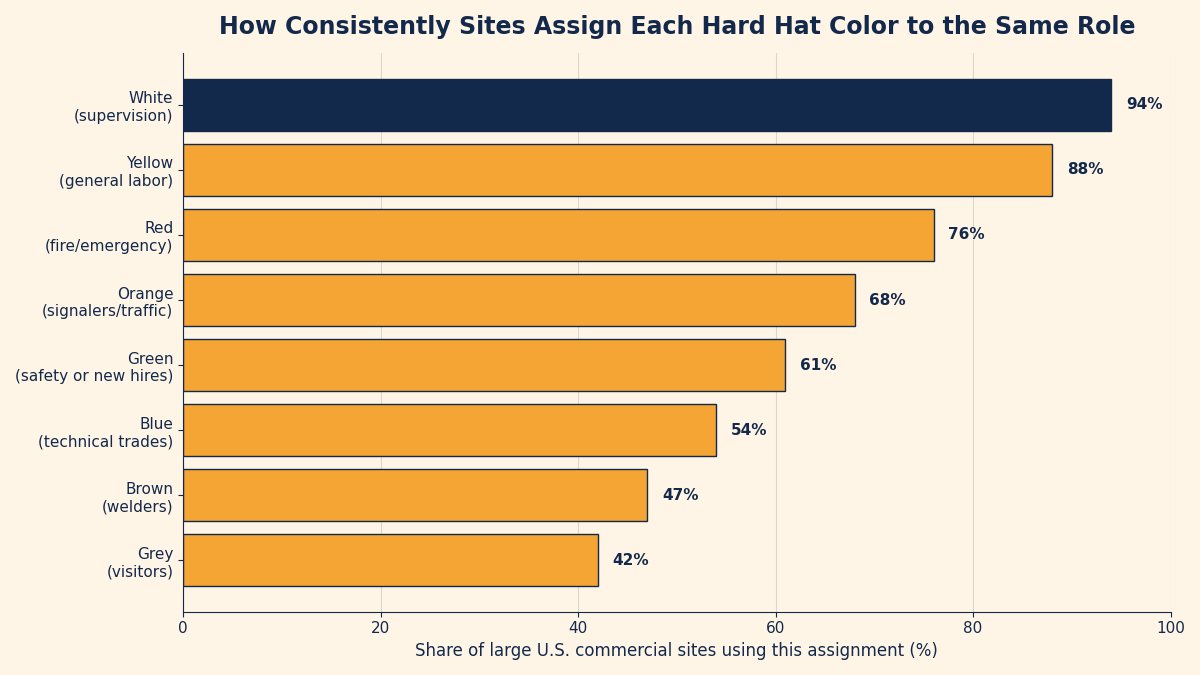
The assignments below reflect the most common conventions on U.S. and Canadian commercial sites. Always defer to the site-specific policy, because the hard hat color code on one project can differ from the one across the street.
| Color | Typical Wearer | Notes |
|---|---|---|
| White | Managers, engineers, supervisors, foremen | The most consistent assignment across the industry |
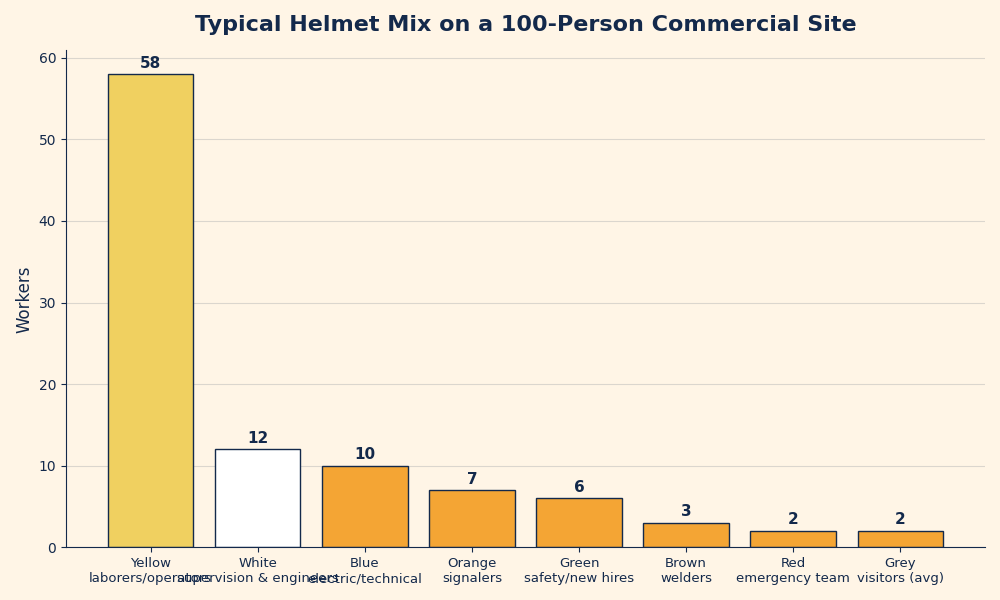
| Yellow | General laborers and earth-moving operators | The default color for the largest share of the workforce |
| Blue | Electricians, carpenters, technical operators | Some sites reserve blue for medical personnel instead |
| Green | Safety inspectors or new/probationary workers | Dual meaning — the site policy must pick one |
| Orange | Road crews, signalers, banksmen, visitors on some sites | High visibility makes it popular near live traffic |
| Red | Fire marshals and emergency response team members | Often paired with a sticker identifying the role |
| Brown | Welders and high-heat trades | Chosen partly because it hides scorch marks |
| Grey | Site visitors | Common where orange is already taken by signalers |
| Pink | Loaner hats on some sites | Used to discourage workers from forgetting their own |
White Hard Hat Meaning: Why Supervision Gets White
The white hard hat meaning is the closest thing the industry has to a universal rule. White became the supervision color for practical reasons: it is easy to spot from a crane cab or an upper floor, it photographs clearly in progress documentation, and it signals authority to inspectors arriving on site. If you are ordering hats for a leadership team, white with a printed company logo is the safe, professional default. Engineers and client representatives typically wear white as well, which is why many sites add a title decal (SUPT, PE, QC) to distinguish them.
Where Color Rules Vary
Regional and industry differences
Oil and gas sites often run stricter schemes than commercial construction, with contractor-specific colors written into the safety plan. UK sites follow a national guidance scheme (black for supervisors, white for site managers and vehicle marshals with a distinguishing feature, orange for slingers/signalers) that differs from North American habit, so multinational crews should never assume the rules travel with them.
Company branding versus site color rules
Many subcontractors want every employee in a branded helmet color. Most GCs will accommodate that for general labor but hold the line on white for supervision and red for emergency roles. The compromise that works on most projects: keep the site’s role colors, and put your branding on the hat via printed logos, so identity and site color rules coexist.
Writing a Color Policy for Your Crew
If you manage a growing contractor, formalize your scheme before your next mobilization. A one-page policy is enough. Cover five points:
- Assign colors by role, not by trade preference. Supervision in white, labor in yellow, safety in green, emergency response in red is a scheme every new hire can learn in one toolbox talk.
- Resolve the green ambiguity. Decide whether green means “safety officer” or “new worker” on your sites and write it down. Some crews use green for safety and a green sticker band for probationary workers.
- Specify the visitor color and stock loaners. Keep a bin of clearly marked visitor hats at the gate.
- Pair color with printed identification. A color tells people the role; a printed logo and name tell them the company and the person. Custom printing also stops the endless hat swapping that undermines any color system.
- Audit condition when you audit color. A color policy review is the natural moment to check shells for cracks, UV chalking, and expired service life.
Common Questions About Site Color Rules
Is any of this required by OSHA?
No. OSHA requires head protection that meets ANSI/ISEA Z89.1 where there is a risk of head injury, but it says nothing about color. Color coding is a site management practice, which is exactly why it varies and why your site orientation matters.
Does helmet color affect heat?
Marginally. Lighter shells reflect more sunlight and can run a few degrees cooler inside, which is one more reason white and yellow dominate outdoor work in hot climates.
Can I print logos on any color?
Yes. Pad printing works on every standard shell color; dark shells simply need light ink. If you are pairing colors with your brand, we cover placement options on our blog, and you can read more about how we work on our about page. For a deeper look at shell types and ANSI classes before you pick colors, see the guides at getcustomhardhats.com. And once your hats are on order, round them out with the right add-ons — our companion guide to hard hat accessories covers face shields, earmuffs, and sweatbands that keep crews comfortable.
The Bottom Line
A hard hat color code costs nothing to implement and pays off every day in faster identification, cleaner coordination, and a safer site. Standardize white for supervision, yellow for labor, green or red for safety roles, define your visitor color, and put your logo on every shell so hats stay with their owners.
Ready to outfit your crew in color-coded, logo-printed hard hats?
Fast turnaround, low minimums, and every ANSI class in stock.