Full-Brim vs Cap-Style Hard Hats: Which to Customize
If your crew is ordering new headgear this season, the first real fork in the road is the full brim vs cap style hard hat decision, not the color or the logo placement. Both shell types meet the same impact and penetration standards, but they protect, fit, and wear very differently once you add a full shift outdoors, a tool belt, or a stack of jobsite accessories. Sorting this out before you order custom-printed shells in bulk saves you from a costly reprint six months later when half the crew wants brim coverage and the other half wants clearance around scaffolding and low ductwork.
This guide walks through where each style earns its keep, how they compare on the numbers crews actually care about, and how the choice affects the logo artwork and print placement you send us. If you already know you need custom printing on either shape, our companion piece on custom hard hat printing methods covers the decoration side in detail.
How the two styles compare at a glance
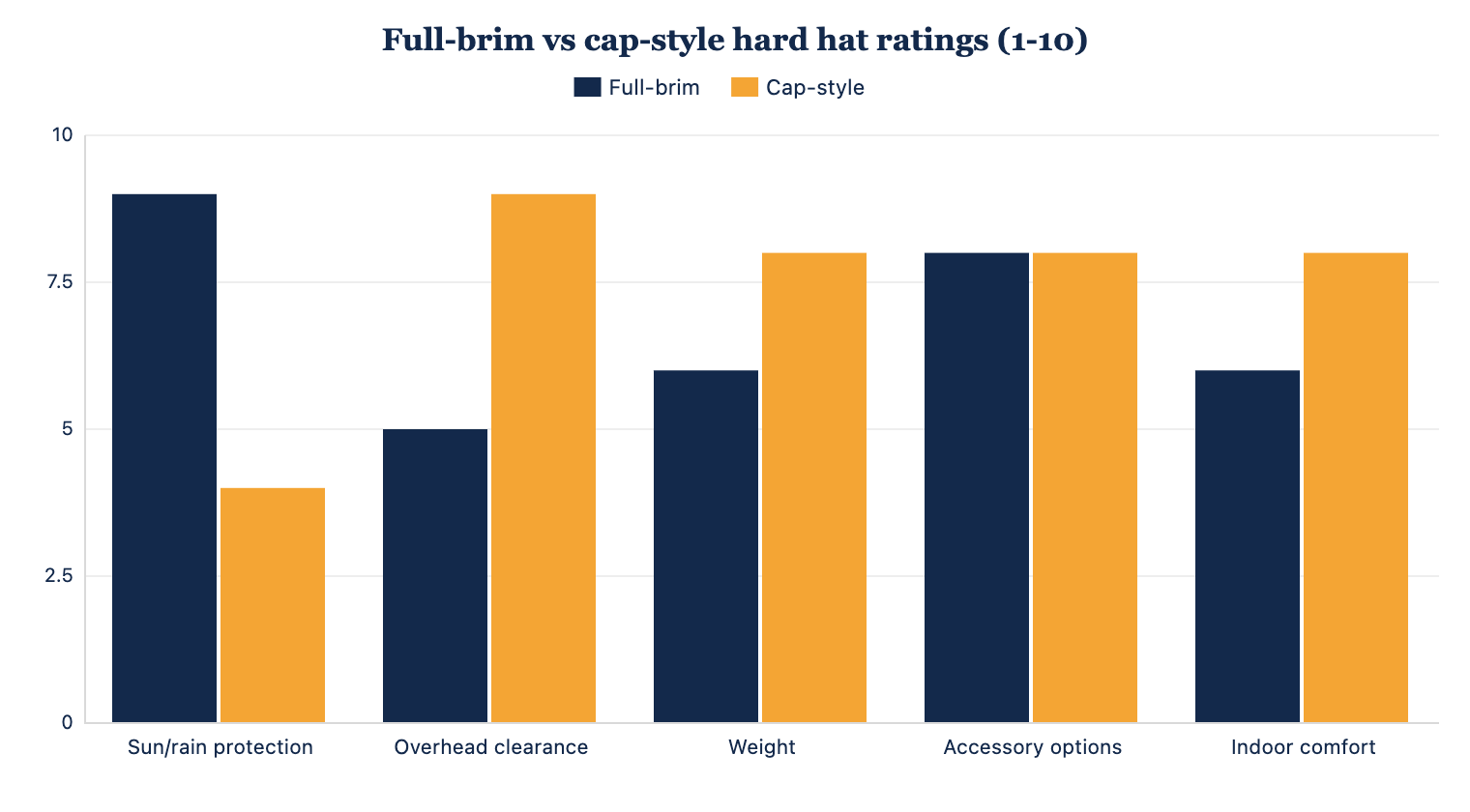
Rating each style across five practical categories on a simple 1-10 scale makes the full brim vs cap style hard hat trade-off easy to see. Full-brim shells win on weather coverage because the brim wraps the entire circumference of the hat, shedding rain and sun off the back of the neck as well as the face. Cap-style shells win on clearance and typically weigh a little less, since there is less shell material and no rear brim to bump into overhead obstructions.
Sun, rain, and weather protection
Full-brim hard hats are the clear choice for anyone spending most of the day exposed to direct sun or repeated rain. The all-around brim shades the face, ears, and back of the neck, which matters most for roadwork, utility line work, and any outdoor job that runs a full eight-to-ten hour shift without much shade. Crews report noticeably less sunburn and glare fatigue by midafternoon when they switch from cap-style to full-brim on exposed sites, though the exact difference depends on latitude, season, and how much of the shift is spent looking up.
Cap-style hats offer only a short front bill, similar to a baseball cap, so rain running off the front still has a clear path down the back of the collar. Some crews pair a cap-style hat with a separate neck shade or add a rain trough accessory, but that is an extra part to buy, lose, and reorder.
Overhead clearance and tight spaces
Cap-style hard hats earn their keep in framing, indoor mechanical work, and any environment with low joists, ductwork, or scaffolding at head height. The absence of a rear brim means less chance of the hat catching an edge when a worker looks up or backs out of a crawlspace. Framers and electricians working under floor trusses consistently prefer the cap shape for this reason alone.
Weight and all-day comfort
Cap-style shells are generally a bit lighter since they use less material, which adds up over a ten-hour shift. Full-brim hats are not heavy by any means, but the extra shell material and, on some models, a reinforced brim edge can add a noticeable amount by the end of the day. Neither difference is dramatic, but workers who already deal with a heavy tool belt or fall-protection harness often notice the smaller savings on the head.
Accessory compatibility
Both styles accept the standard universal or slotted accessory rails used for face shields, ear muffs, and headlamps, so accessory compatibility is rarely the deciding factor. The one exception is welding shields and some brands of full face shields, which occasionally fit a bit more securely on a cap-style shell because there is no brim edge to clear. If your crew regularly swaps shields and muffs on and off, check the specific accessory’s compatibility notes before ordering either shape in bulk.
Who actually wears which style
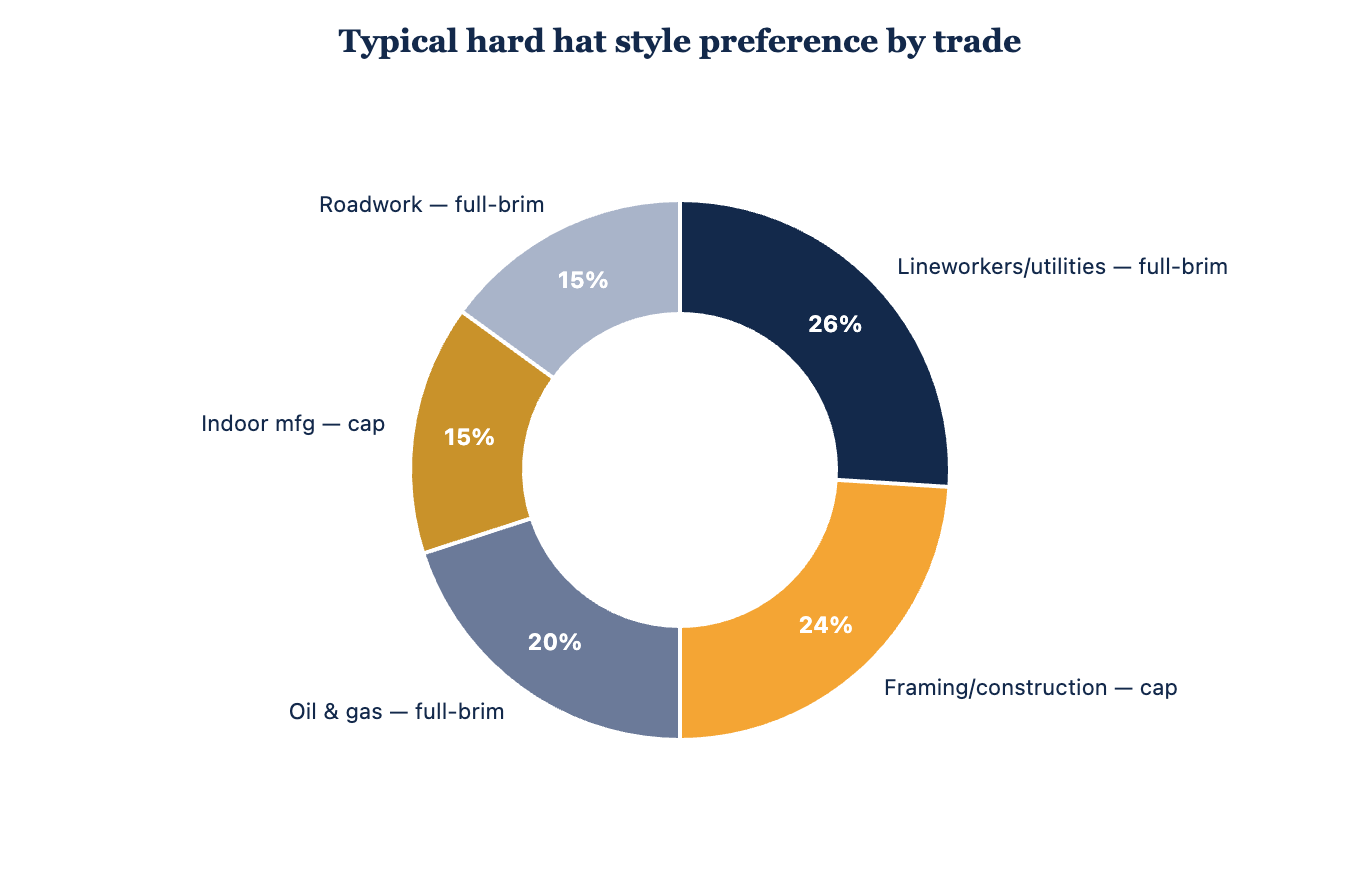
Industry habits are fairly consistent once you look at who buys which shape. Full-brim hats dominate on jobs with heavy sun exposure and vertical work, while cap-style hats dominate in framing and structured indoor environments. The mix below reflects typical ordering patterns we see across trades, not a fixed rule; plenty of crews mix both shapes on the same site depending on task.
| Factor | Full-brim | Cap-style |
|---|---|---|
| Sun/rain coverage | Full 360-degree brim | Front bill only |
| Overhead clearance | More prone to snagging | Lower snag risk |
| Typical weight | Slightly heavier | Slightly lighter |
| Best fit for | Utilities, oil & gas, roadwork | Framing, indoor manufacturing |
| Logo print area | Front, sides, brim underside | Front, sides, back panel |
Indoor manufacturing vs. outdoor exposure
Indoor manufacturing floors, warehouses, and assembly lines rarely need brim coverage at all, since there is no sun or rain to manage and overhead conveyors, racking, and low doorways make a cap-style shell the more practical everyday choice. Outdoor trades with long exposed shifts, especially utility and lineworker crews who spend hours looking up at overhead equipment, tend to standardize on full-brim across the whole team once they have tried both.
What this means for your custom order
Both shapes take a printed logo well, but the panel shapes differ slightly, so send us the shell style along with your artwork so placement is proofed correctly the first time. Cap-style hats give you a clean, flat front panel and two side panels, which is the most common layout for a company name plus a smaller safety or crew designation on the side. Full-brim hats add the option of printing along the underside of the brim, a spot crews sometimes use for a safety slogan or QR code since it stays out of direct weather and is only visible when the hat is lifted or set down.
If your team is mixed, ordering both shapes in the same color and print layout keeps the crew looking uniform on site and in photos, which matters more than people expect for client-facing work. Learn more on our about page about how we manage bulk orders for mixed fleets, or head back to the homepage to start a spec sheet for your crew.
Bottom line
There is no universal winner in the full brim vs cap style hard hat comparison; the right pick depends on how much sun and rain your crew faces versus how much overhead clearance the job demands. Match the shape to the work first, then customize the print layout to fit the shell you chose.
Ready to customize your crew’s hard hats?
Tell us your shell style, quantity, and logo and we will send a proof with accurate placement for full-brim or cap-style shells.
Get a QuoteHome · About · Buying guides · Companion guide: custom hard hat printing methods