If you’ve ever stood in front of a wall of helmets wondering what the labels actually mean, you’re not alone. The two most confusing parts of choosing head protection are the hard hat types and the hard hat classes—and people mix them up constantly because they sound similar but describe completely different things. One covers where impact protection comes from; the other covers electrical protection. This guide explains both in plain English, what the colors typically mean, and when to retire a helmet, so you can match the right hard hat to the job.
Hard hat types vs classes: what’s the difference?
This is the distinction that trips everyone up, so it’s worth getting clear first. In the U.S., hard hats are described by the ANSI/ISEA Z89.1 standard, which uses two separate labels: type and class. Type tells you the direction of impact the helmet is built to absorb. Class tells you how much electrical protection it offers. A single hard hat carries both labels—for example, “Type I, Class E”—so you’re really making two decisions at once. The values are printed on a label inside the shell.
Hard hat types: Type I vs Type II
There are two hard hat types, and the difference is simply where the impact comes from.
| Type | Protects against | Typical use |
|---|---|---|
| Type I | Impact and penetration to the top of the head | General construction, falling-object hazards from above |
| Type II | Top and lateral (side) impact | Sites with side-impact risk; often more padded/cushioned |
Type I is the most common helmet on a typical site, where the main danger is something dropping from above. Type II adds an internal liner to absorb glancing or sideways blows and is chosen where workers face that risk. Many modern “safety helmets” with chin straps are Type II. Always match the type to the hazards in your specific work environment.
Hard hat classes: G, E, and C
Classes are all about electricity—specifically how much voltage the shell is tested to withstand. This is critical for anyone working near electrical hazards.
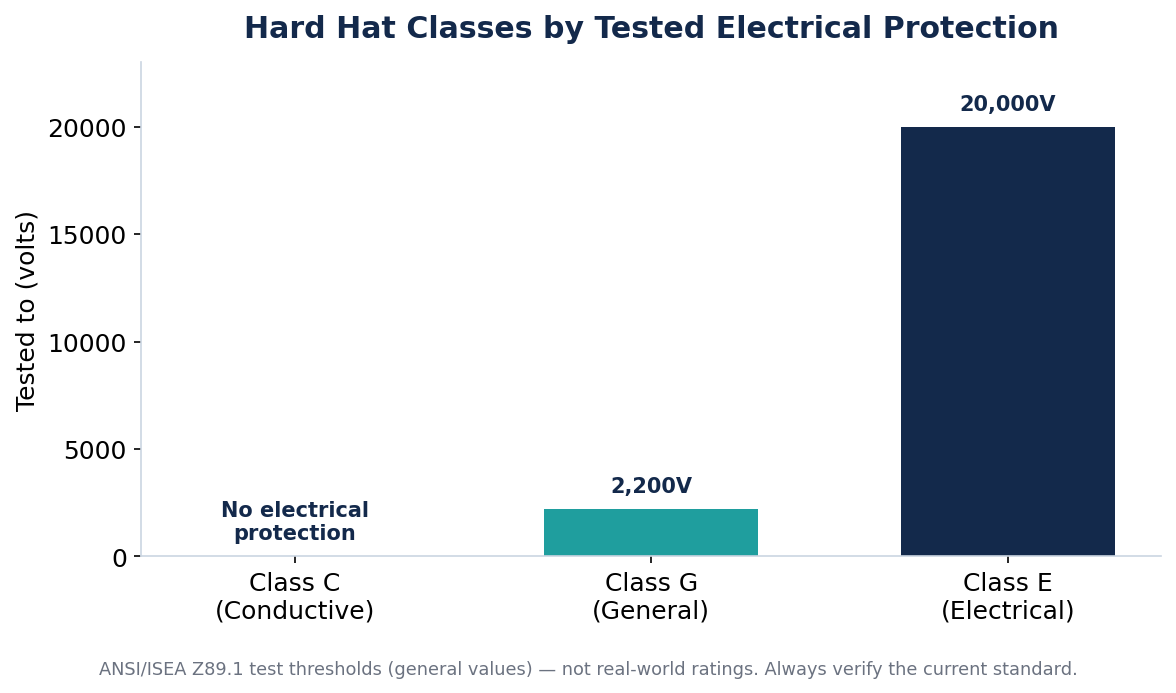
| Class | Stands for | Electrical protection (tested to) |
|---|---|---|
| Class G | General | Up to 2,200 volts |
| Class E | Electrical | Up to 20,000 volts |
| Class C | Conductive | None — not for electrical hazards (often vented) |
A quick way to remember it: G for general, E for the highest electrical protection, and C for conductive—meaning it offers no electrical protection and may have vents that conduct. The voltage figures are laboratory test thresholds, not real-world ratings, and they don’t replace proper electrical safety procedures. Confirm the class your work requires before you buy.
What do hard hat colors mean?
Hard hat colors aren’t governed by ANSI—they’re an informal convention that varies by company, region, and industry. Many U.S. and UK sites follow a rough pattern, but it is never universal, so always defer to your own site’s color policy.
| Color | Commonly (not always) indicates |
|---|---|
| White | Managers, engineers, supervisors, foremen |
| Yellow | General laborers and operators |
| Blue | Electricians, technical/temporary staff |
| Green | Safety officers, new workers |
| Orange | Road crews, banksmen, high-visibility roles |
| Red | Fire marshals / emergency response |
Because the color code isn’t standardized, it’s mainly useful for spotting roles at a glance on a busy site. Companies often pick colors that match their branding too, which is one reason custom hard hats are popular—you can design hard hats in your company colors while keeping the correct type and class for the job.
When should you replace a hard hat?
A hard hat is a one-impact product and degrades over time even if it looks fine. General guidance from manufacturers and safety bodies:
- After any impact—replace immediately, even with no visible damage.
- Shell: many makers suggest replacing roughly every 5 years from first use.
- Suspension (the inner harness): often replaced every 12 months.
- On sight of damage: cracks, dents, chalky/faded shell, or a brittle suspension.
- UV & chemicals: sun exposure and solvents weaken the shell faster.
These are general rules of thumb—always follow the date stamp inside the shell and your manufacturer’s and employer’s specific replacement schedule.
Choose the type and class your job requires, then add your company colors and logo in our builder.
Design your hard hats →Outfitting a team or want logo branding? Read our companion guide to custom logo hard hats, or browse ready-to-personalize options in our custom hard hat collection.
Frequently asked questions
What is the difference between Type 1 and Type 2 hard hats?
A Type I hard hat protects against impact to the top of the head, while a Type II hard hat protects against both top and lateral (side) impacts, usually with extra internal cushioning. Choose Type II where side-impact hazards exist. Both are defined under the ANSI/ISEA Z89.1 standard.
What are the hard hat classes G, E, and C?
The classes describe electrical protection: Class G (General) is tested to 2,200 volts, Class E (Electrical) is tested to 20,000 volts, and Class C (Conductive) offers no electrical protection and is often vented. Match the class to your electrical hazard and verify against the current standard.
Do hard hat colors mean anything?
Hard hat colors are an informal convention, not an ANSI rule, so they vary by company and country. Common patterns are white for supervisors, yellow for laborers, and blue for electricians, but you should always follow your own site’s color policy.
How often should you replace a hard hat?
Replace a hard hat immediately after any impact. As general guidance, many manufacturers suggest replacing the shell about every 5 years and the suspension about every 12 months, sooner if you see cracks, fading, or brittleness. Always follow the date stamp and your manufacturer’s schedule.
This is general educational information, not safety certification. Hard hat standards (ANSI/ISEA Z89.1) and requirements change—always verify the current standard and your employer’s and manufacturer’s guidance before relying on any hard hat. Last reviewed: 2026.