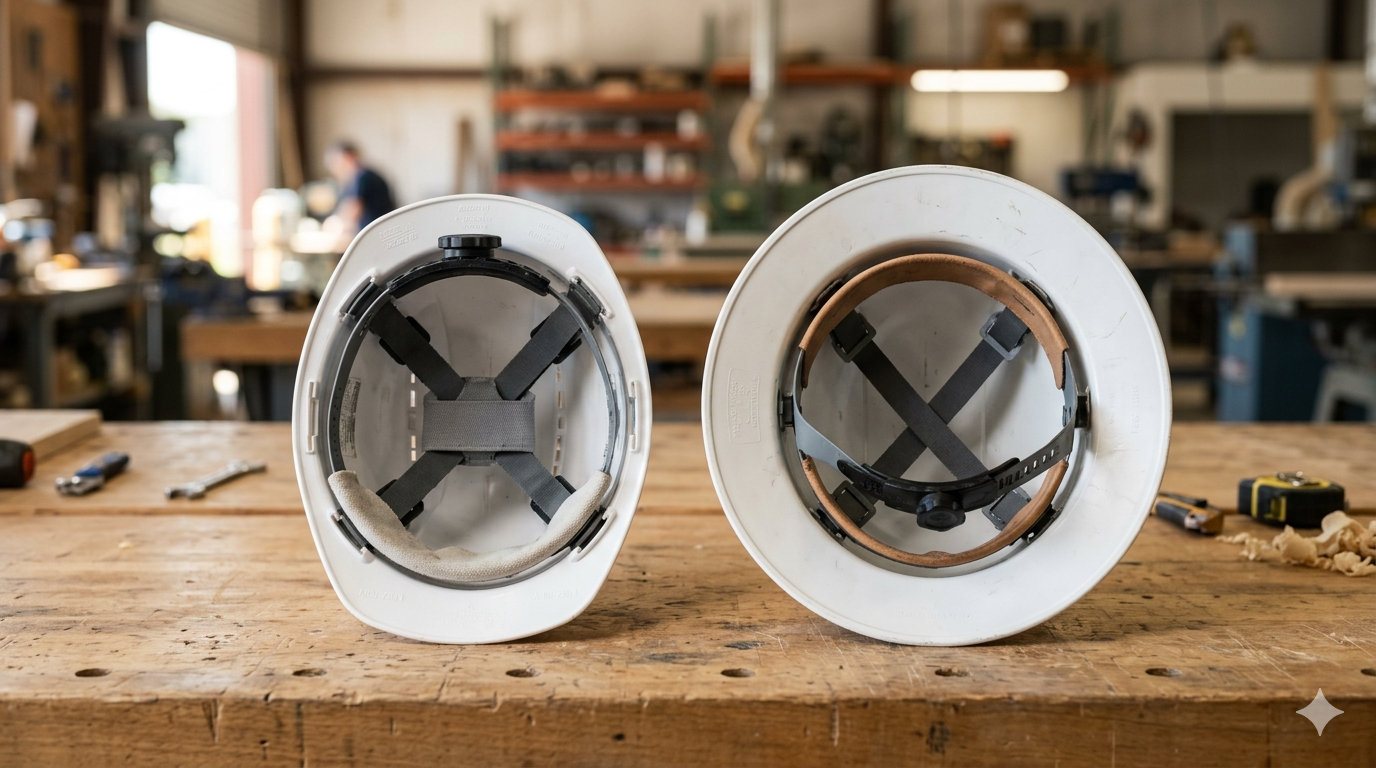
ANSI Type I vs Type II hard hat is the question every safety officer should be able to answer for their crew, and most can’t. The two types differ specifically in side-impact protection — not just a cosmetic distinction. This guide walks through the ANSI Z89.1-2014 standard, the practical difference between Type I and Type II hard hats, and which one your jobsite needs.
What ANSI Z89.1-2014 Actually Tests
ANSI Z89.1-2014 is the American National Standard for industrial head protection. It defines two types of hard hats based on impact direction: Type I provides protection against impact to the top of the head, and Type II adds protection against side and rear impacts.
Both types are tested for force transmission, penetration resistance, and (for Class E and G) electrical insulation. The difference between Type I and Type II is specifically in the side-impact and rear-impact testing protocol that Type II adds.
Type II hard hats have additional foam liner around the sides and back of the shell, which absorbs lateral impact in a way that Type I hats don’t.
When Type I Is Sufficient
For traditional construction, framing, and trade work where the risk profile is overhead falling objects (dropped tools, falling debris, low-clearance overhead), Type I is the standard and is what most US construction sites use today. Type I hard hats handle vertical impact, which covers the most common jobsite hazard.
Most general contractors, framing crews, plumbers, electricians, and tradespeople work in Type I as their default. Costs are lower, the hard hats are widely available, and the protection level matches the typical risk.
When Type II Is Required (or Smart)
Type II is increasingly required in industries where lateral impact is a real hazard. Examples include refinery and petrochemical work where workers maneuver in tight spaces with side projections, demolition where falling debris can come from any angle, mining and tunneling where rockfall has unpredictable trajectories, and emergency response where workers may be struck from the side by debris or moving equipment.
For traffic-adjacent work where a vehicle impact is a credible risk, Type II is the smarter choice. Some state DOTs and federal contracts now specify Type II for road and highway work.
Even where not required by spec, Type II is becoming a more common safety officer recommendation. The cost difference (typically $5–15 per hat) is small relative to the additional protection.
Hard Hat Standards Beyond Type
Both Type I and Type II hard hats also carry a Class designation: Class E (electrical, up to 20,000V), Class G (general, up to 2,200V), or Class C (conductive, no electrical protection). Most general construction uses Class E or Class G; Class C is for environments with no electrical hazard but where ventilation matters.
The classification combo (Type I + Class E vs Type II + Class G) is what your spec should reference. Don’t order “hard hats” without naming the type and class.
Customizing Hard Hats Without Voiding the Standard
Decoration on a hard hat — logo, color coding, name — must be applied without compromising the shell’s impact protection. We use vinyl decals, screen-printed graphics, and engraved name plates that adhere to the shell without altering its structural integrity. The ANSI rating is preserved.
Drilling holes through the shell for accessories voids the rating. Aftermarket attachments that pierce the shell are not permitted. We can apply branded chinstraps, neck shades, or accessories that integrate with the existing shell vents or pre-cut accessory slots.
Spec’ing the Right Bulk Order
For a typical 30-person construction crew, the practical spec is Type I + Class E for general fieldwork, Type II + Class E for the foreman and supervisor (more lateral hazard exposure during inspections), with the company logo applied via vinyl decal in zones that don’t alter shell structure.
Need to confirm hard hat standards for your jobsite? Request a quote with your industry, project type, and quantity, and we’ll spec the right type/class combination.
GET A QUOTE