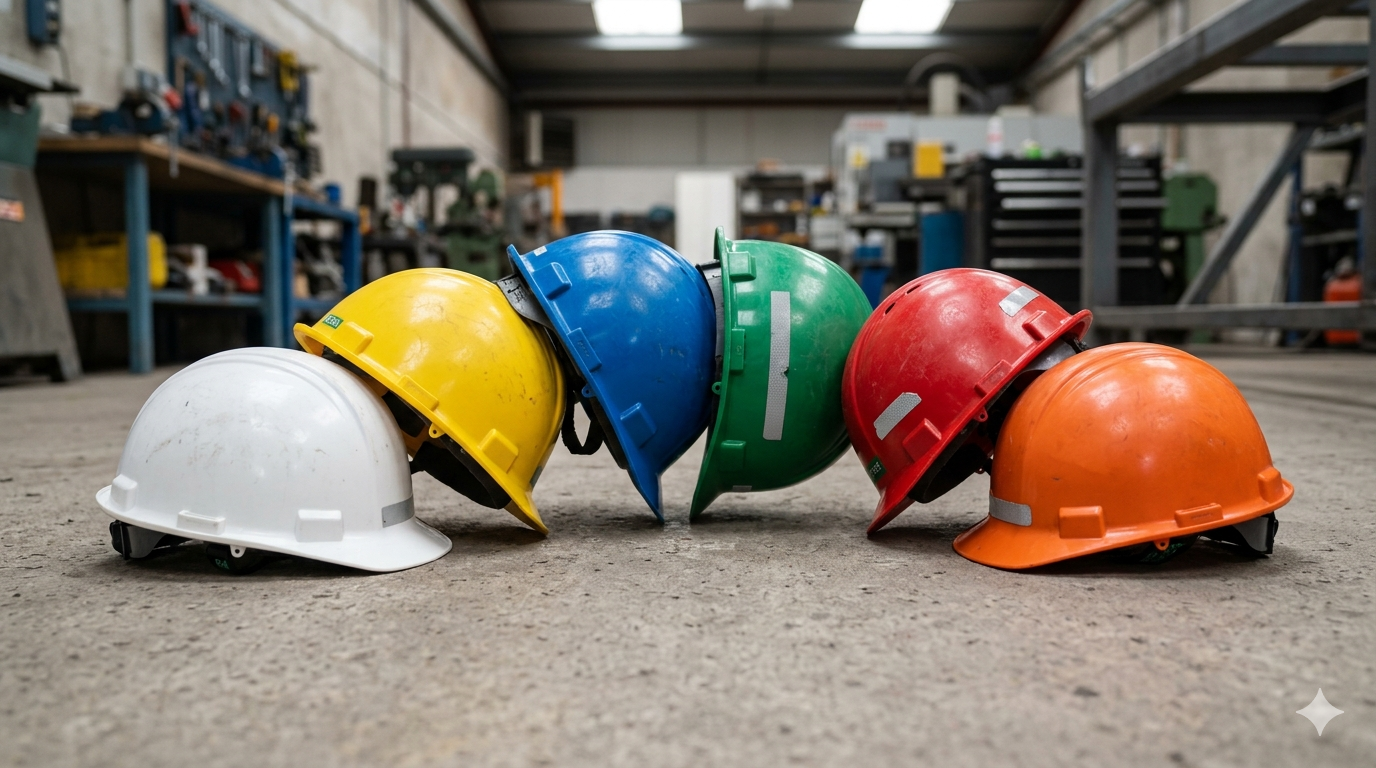

If you walk onto a major construction site for the first time, you will notice that hard hat colors are not random. White means one thing, yellow means another, and the visiting OSHA inspector probably wears something completely different. The convention is not federally mandated in the United States, but it is common enough that most sites you will work on follow it. Here is the breakdown.
The standard convention
White — Site supervisors, foremen, engineers, architects. The decision-maker color. If something needs approval, find a white hat.
Yellow — General laborers and earth-moving operators. The largest group on most sites. If you are new to a site and do not know what color to wear, yellow is the safest default.
Blue — Electricians, carpenters, and other technical operators. Trades that require specialized training but are not running the site.
Green — Safety officers and inspectors. The person making sure no one gets hurt. Green hats often get extra acknowledgment because their job is to call out unsafe behavior.
Red — Fire marshals, emergency response, and emergency medical personnel. Red is reserved so that in an actual emergency, the responders are visible at a glance.
Brown — Welders and workers handling high-heat applications. Brown is also chosen because it hides scorch marks better than lighter colors.
Gray — Visitors. Anyone on site without an assigned role — clients, vendors, journalists, family members on a tour. Gray makes it instantly obvious who needs an escort.
Pink — Often the loaner or spare color. Some sites use pink intentionally to discourage people from borrowing loaner hats permanently.
Where the convention breaks down
This system is not OSHA-mandated, is not ANSI-mandated, and is not universal. Union sites in different regions have their own conventions. International sites may follow different schemes. If you are moving between sites, confirm the local color code before walking in.
Setting up your crew
If you are outfitting a crew from scratch, the easiest move is to follow the US convention above. Pick whatever 4–6 colors map to the roles on your site, order custom hard hats in those colors with your company logo on each, and post a simple poster in the trailer showing the color code. Crews adopt color codes faster when they are displayed, not just spoken about.
What to add beyond color
Color identifies the role; a name decal or printed name on the back identifies the person. Most sites add the worker first or last name to the back of the hat. Some add a number for tracking. If your crew rotates between sites, consider a small printed icon for the company too — it speeds up the morning gate check.
Custom hard hat color orders
When ordering custom hard hats with color coding, send your supplier the breakdown by role + quantity per color, not just the total. A typical 100-hat order might be 60 yellow, 15 white, 10 blue, 8 green, 5 red, and 2 gray. Suppliers can match almost any color, but unusual colors often need a longer lead time.
Color coding seems like a small thing until the day a forklift driver cannot tell at a glance who has the authority to wave them through.